Showing posts with label Censorship. Show all posts

Tuesday, November 19, 2013

Film Ratings: Sensible or Censorship?


If you live in the United States, it is likely that your television set contains a V-chip, used in accordance with the 2008 Child Safe Viewing Act. These chips, mandated by the Federal Communications Commission (FCC), allow TV users to voluntarily censor their household from television and movies that earned certain ratings.
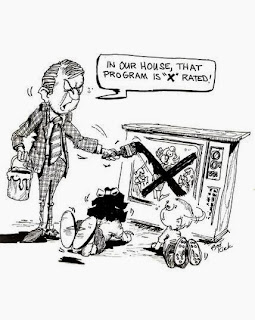

Because of an influx of technology plus an increase of violence among children (citing the Desensitizing Theory), film and television ratings have gotten more attention.

This post will compare the United States' rating system (regulated by the Motion Picture Association of America - MPAA) and that of Britain (regulated by the British Board of Film Classification - BBFC). The BBFC and MPAA function as gatekeepers.

Both systems are very similar. And both focus on protecting children, an idea not uncommon in the media industry.

For the sake of brevity, this post will compare BBFC's "18" rating with MPAA's "R" rating.

BBFC's "18"
BBFC ratings breakdown. 
  • No children under 18 can see the film in theaters or buy/rent a copy.
  • "Adults are free to pick their entertainment under the law."
  • These films may contain:
    • Very strong and detailed violence
    • Frequent strong language
    • Strong portrayals of sexual activity
    • Strong horror
  • However, these may be cut from the film:
    • Material that breaches criminal law
    • Material that harms individual morals


MPAA ratings breakdown.

  
  MPAA's "R(estricted)"
  - Children under 17 require an accompanying    parent or guardian.
  - It is "not appropriate for parents to bring their    children to an R-  rated movie."
  - These films may contain:
     - Intense or persistent violence
     - Hard language
     - Sexually-oriented nudity


It appears that Britain is more lenient once a child reaches 18, marking them as adults. In the United States, however, R-rated movies are available to 17 year-olds so these films may be less graphic.

It is also interesting to note that the BBFC and MPAA are private media businesses. This injects economics directly into the ratings system and begs the question of objectivity. 

Ultimately, ratings lose to the uses and gratification approach. Media users are attracted to the types of content that meet their psychological and social needs, no matter the film rating.

At a basic level, ratings are censorship. Organizations like the BBFC and MPAA examine material and remove parts that are harmful, or rate it "higher" to limit access. However, even in two countries that value freedom of expression, the ratings system provide the benefit of protection, something worth the regulation.

Check out the full sources for more info.


Monday, November 4, 2013

Chinese Citizens Develop Online Code Bypassing Censorship

While China’s “Great Firewall” of internet censorship is often criticized as being undemocratic and grossly ubiquitous, there is actually an online code being developed by Chinese citizens that not only bypasses regulators, but creates new conceptions of news and community. This code has created a subtle compromise between the Chinese public and its government – between the people’s need for expression and the government’s need for control.

Xiao Qiang, editor of the
China Digital Times
NPR recently unveiled the reality of the code through an interview with Xiao Qiang, the editor of the China Digital Times. Qiang described the phenomenon as the creation of a “public” code, not a “secret” code. For instance, “May 35” is code for June 4, the day of the 1989 Tiananmen Square massacre, yet the code is commonly understood by both the government and the public to mean just that. It is no secret at all. In fact, the coding is so universal that it is rather not a code at all; it is an online language.

Consequently, political criticism is often present on Chinese servers because it passes through surveillance by being indirect. This indirectness is the compromising factor between the Chinese public and government. As long as the commentary is technically ambiguous, and balancing the fine line, the government does not censor it. Allowing some leniency helps the regime stay in control by letting its citizens express grievances in non-violent ways. Above all, China does not want protests. What is targeted the most under the “Great Firewall” is any text indicating a call to action.

This disrupts traditional methods of community building whereby a mass message about a problem is sent out, and then alike individuals gather together in person to solve it. However, it reversely creates a new version of community building by which people meet on the web to discuss their problems. They even discuss those problems through a new language, which they add on to through the endless interactivity that web communication offers.

The creation of the online community also establishes a news hub which is an alternative to the propaganda inflicted news of the government. Citizens can now perceive two different stories, one of which is given validity by the cultivation of multiple accounts online.

Nevertheless, while NPR provides an insider’s view on Chinese internet regulation, other reports such as an article titled “Crackdown on Bloggers Is Mounted by China” describe a far more restrictive situation. While user-generated opinion is growing more powerful, bloggers still have to be careful as government officials can detain offenders for “malicious rumor-mongering online.” So for now, balancing the fine line may not be as common, or easy, as some testimonies might suggest.

Sources:
Related Sources:

Agenda-Setting and Regulation in Egypt


This blog is dedicated to exploring mass communication practices abroad, especially compared to United States practices. In my last post, I explained Nike's advertisement formula used across international borders. Today, I will discuss the different news practices used internationally, specifically in Egypt.

Bassem Youssef is an Egyptian satirist who hosts a talk show comparable to the U.S.'s Daily Show with Jon Stewart. As you can imagine, this job, in Egypt, is no piece of cake. Recently, private news channel CBC canceled his show claiming he had not followed their editing requirements. Shortly after, Bassem was arrested under charges brought on by leaders of the Egyptian Lawyer's Union.

Studying mass media effects in this case concerns agenda setting both with regards to how and why Bassem was arrested, and with regards to the news coverage of that arrest. I will be analyzing the latter of these two areas.

  • Agenda-Setting is the theory that suspects media do not reflect reality, rather, they filter and shape it. 

Maxwell E. McCombs and Donald L. Shaw conducted a study titled "The Agenda-Setting Function of Mass Media" on voters in Chapel Hill, North Carolina. From their results, they concluded: “the evidence is in line with the conditions that must exist if agenda-setting by the mass media does occur.” This study proved that media distort reality, and, in this case, reflect the views and opinions of whoever is in charge; we can call these regulators. 

Egypt News Daily's post about Bassem report the opinion of the State Commission, which, to the news outlet, is a worthy source. It says, "The report [the State Commission's] meanwhile warned that freedom of expression should respect wider societal values and morals in Egypt, not attack or waste efforts by the state." Egypt News Daily is providing for its readers support for the notion that the state should supersede civil rights such as freedom of speech.

We know that, behind the scenes, Egypt News Daily is either required to report what the government dictates to them, or it is, itself, government owned. Regulation is a key factor here. Regulation in America takes place in the form of the FCC, a government agency, but in countries like Egypt, regulators reign.

  • Regulation is, in this case, censorship dictated by an authoritarian government.

Other news outlets (I'll look at two American ones for the sake of this project) attempt to expose the censorship that the Egyptian government imposes on its people. CNN's video on Bassem contains an interview from earlier this year in which Bassem says "the solution for bad speech is not less speech it is more speech." Bassem, a strong supporter of freedom of speech, is only able to voice his opinions on foreign news platforms. It is of vital importance that he is allowed this opportunity.

Other than giving Bassem a voice, American news has provided commentary on what his arrest means for the situation in Egypt. Washington Post's article on Bassem is titled "Wow. Nearly half of Egyptian support suspending TV satirist Bassem Youssef." This title, alone, expresses the unbelieving disapproval of Americans' towards any country that may limit freedom of speech. The "Wow" seems to scoff at citizens who would support regulators to control the flow of news.

Sources:
Egyptian satirist Bassem Youssef
"The Agenda-Setting Function of Mass Media"
Egypt News Daily's post about Bassem
FCC
CNN's video on Bassem
Washington Post's article on Bassem