If you live in the United States, it is likely that your
television set contains a V-chip, used in accordance with the 2008 Child Safe Viewing Act. These chips, mandated by the Federal Communications Commission (FCC), allow TV users to voluntarily censor their
household from television and movies that earned certain ratings.
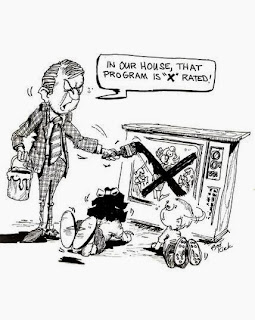
Because of an influx of technology plus an increase of violence among children (citing the Desensitizing Theory), film and television ratings have gotten more attention.
This post will compare the United States' rating system (regulated by the Motion Picture Association of America - MPAA) and that of Britain (regulated by the British Board of Film Classification - BBFC). The BBFC and MPAA function as gatekeepers.
Both systems are very similar. And both focus on protecting children, an idea not uncommon in the media industry.
For the sake of brevity, this post will compare BBFC's "18" rating with MPAA's "R" rating.
BBFC's "18"
 |
| BBFC ratings breakdown. |
- No children under 18 can see the film in theaters or buy/rent a copy.
- "Adults are free to pick their entertainment under the law."
- These films may contain:
- Very strong and detailed violence
- Frequent strong language
- Strong portrayals of sexual activity
- Strong horror
- However, these may be cut from the film:
- Material that breaches criminal law
- Material that harms individual morals

- Children under 17 require an accompanying parent or guardian.
- It is "not appropriate for parents to bring their children to an R- rated movie."
- These films may contain:
- Intense or persistent violence
- Hard language
- Sexually-oriented nudity
- It is "not appropriate for parents to bring their children to an R- rated movie."
- These films may contain:
- Intense or persistent violence
- Hard language
- Sexually-oriented nudity
It appears that Britain is more lenient once a child reaches 18, marking them as adults. In the United States, however, R-rated movies are available to 17 year-olds so these films may be less graphic.
It is also interesting to note that the BBFC and MPAA are private media businesses. This injects economics directly into the ratings system and begs the question of objectivity.
Ultimately, ratings lose to the uses and gratification approach. Media users are attracted to the types of content that meet their psychological and social needs, no matter the film rating.
At a basic level, ratings are censorship. Organizations like the BBFC and MPAA examine material and remove parts that are harmful, or rate it "higher" to limit access. However, even in two countries that value freedom of expression, the ratings system provide the benefit of protection, something worth the regulation.
Check out the full sources for more info.
- Sources used in this article:
- "Comfortably Numb" by Brad Bushman and Craig Anderson
- "The V-Chip" by FCC
- U.S. Constitution - Amendment 1
- "Uses and Gratifications Theory in the 21st Century" by Thomas Ruggiero
- Sources for extra information:
- BBFC website
- "Censor" by Merriam-Webster Dictionary
- FCC website
- "MPAA defends its ratings system" by Entertainment Weekly
- MPAA website
